

 Jorge Chirinos - IA Product Manager Senior
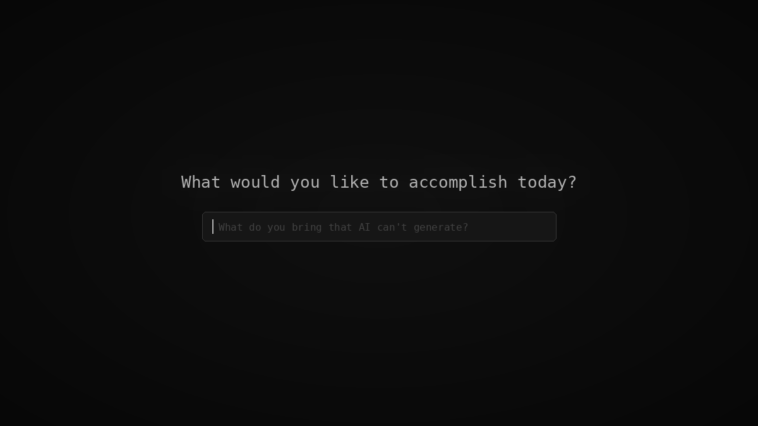
Imagine turning on your computer tomorrow. No Windows. No macOS. No Word. No Excel. No PowerPoint. No VS Code. No Figma. No Jira. No Slack. No Salesforce. No SAP.
Just a prompt:
“What would you like to accomplish today?”
That one screen change erases decades of skills overnight. Every shortcut you memorized. Every formula you mastered. Every template you perfected. Every tool you spent years learning to operate at speed. Gone.
The prompt is waiting. It can build anything. But it doesn’t know what to build.
Now what?
If all you bring to your job is the ability to operate those tools well — you have nothing to type. That blank prompt is a mirror. And most people won’t like what they see.
This isn’t speculation. This isn’t a thought experiment for 2030.
Dario Amodei — CEO of Anthropic, the company behind Claude — said at Davos last month that his own engineers don’t write code anymore. They edit what AI produces. He said AI models could do “most, maybe all” of what software engineers do within six to twelve months. Days later, Mustafa Suleyman — CEO of Microsoft AI — told the Financial Times that lawyers, accountants, project managers, and marketers will be “fully automated by AI within the next 12 to 18 months”.
These aren’t analysts on Bloomberg making predictions. These are the people building the technology, giving you timelines. And they’re not hedging. This is coming. The only question that matters is whether you’re standing on task or on discernment when it arrives.
Let me define those terms, because that line will determine who stays and who doesn’t.
Task is operating the tool. It’s the thing you do with your hands. Formatting a document. Building a pivot table. Writing code. Designing a wireframe. Creating a slide deck. Running a report. These are processes — learnable, repeatable, describable. If you can write a manual for it, AI can do it.
Discernment is knowing what to tell the tool — and why. It’s the judgment that comes before the first click. It’s understanding what actually needs to exist, for whom, under what constraints, and why the obvious approach is wrong. It’s the ability to question the question.
AI is extraordinary at task. It is incapable of discernment. And most careers have been built almost entirely on task.
I know this because I’ve lived on both sides.
I’m a software engineer with 25 years of experience. For most of those years, my tools were IDEs, databases, deployment pipelines, and late nights debugging code nobody else wanted to touch. I was good at it. I was fast. I was reliable.
And last year, I realized that almost none of that is what saved the projects that mattered.
I was asked to build an AI-powered chatbot for a government platform in Peru serving over 1,800 municipalities — the system that connects local governments to the national tax administration. The platform operators needed instant answers. Citizens needed clarity on legislation and procedures. The volume was massive.
The standard approach? Cloud-based AI services. Enterprise licenses. GPU infrastructure. A budget to match.
We had none of it. No GPU. No cloud AI budget. 32 gigabytes of RAM. A CPU-only server. And the expectation that it would work.
Every colleague, every vendor, every conventional playbook said the same thing: you need more resources. That’s a task response — reaching for the familiar tool and finding it unavailable.
I asked a different question: what do these operators and citizens actually need, and what’s the simplest architecture that delivers it reliably under these constraints?
I designed a three-tier system. First layer: an exact-match cache that returns answers in under 5 milliseconds for questions the system has seen before. Second layer: a semantic search that finds the closest match when the question is new but similar to something known. Third layer: a lightweight language model as a fallback for everything else. All running on CPU. All built on the principle that 99.99% of what people ask falls into patterns — and you don’t need a massive model to serve patterns. You need discernment to recognize that fact.
It worked. Not in theory. In production. Serving real municipalities. Answering real questions about real legislation.
An AI could have written every line of code in that system. What it couldn’t have done is look at an impossible set of constraints and see them not as blockers — but as design variables. That decision happened before a single line of code was written.
Then came the second project. Same platform. Same constraints. This time the ask was business intelligence — dashboards to show municipalities how they were performing.
The responses were immediate and predictable. Colleagues said Power BI. Others said Tableau. Someone suggested building a traditional data cube with a star or snowflake model. All legitimate tools. All task-level responses to what was actually a design-level problem.
I closed the tools and asked a different question: what do 1,800 municipalities with wildly different technical capacity, budgets, and staff actually need?
With Power BI or Tableau, the large municipality with budget and trained staff builds beautiful dashboards. The small municipality in a remote province with no technical capacity builds nothing. They stare at a tool they can’t use. The information gap between rich and poor municipalities doesn’t close — it widens. The tool choice itself creates inequality.
Nobody in the room saw that. They were answering “what BI tool should we use?” I was answering “how do we make sure every municipality — regardless of size, budget, or technical ability — sees its own performance with equal clarity?”
So I designed something unified. Nine dashboards covering the platform’s top operational modules. One master dashboard summarizing all nine. Browser-based. No licenses required. No training needed. Same metrics everywhere. Same visual language. Same clarity. Different numbers. A municipality of 5,000 people sees its management performance with the same precision as one of 500,000.
That’s not a technology decision. That’s leveling the field. That’s a conviction about equity of access that no AI would have generated unprompted.
And here’s what connects both stories to the blank prompt on your screen tomorrow: I used AI to build the HTML prototypes for those dashboards. No wireframe sessions. No dedicated UX designer. No weeks of back-and-forth with a design team. Hours, not weeks. I shared the working prototypes directly with upper management to validate the vision, with subject matter experts to confirm the operational logic, and with developers so they could see exactly what they were building.
AI did the task — and it did it brilliantly. Fast, clean, precise. I provided the discernment — what to build, for whom, under what constraints, with what philosophy. Together, we were unstoppable. Either one alone would have produced nothing useful.
That’s not a story about AI replacing me. It’s a story about AI multiplying what my 25 years of judgment made possible. But without those 25 years — without the ability to question the question, reject the obvious tool, and see constraints as design opportunities — the AI would have sat there waiting.
Just like that prompt on your screen tomorrow.
This pattern isn’t unique to software engineering. It’s everywhere.
Think about what a marketer actually does before a campaign launches. Weeks of market research. Audience segmentation. Competitive analysis. Messaging frameworks. A/B test design. Asset production — graphics, copy, video, landing pages. Performance tracking setup. Reporting templates. Campaign after campaign, this cycle repeats. And every step of that cycle is task. Every step is automatable. Not in 18 months — much of it is automatable right now.
So what’s left when AI compresses that entire cycle into minutes?
What’s left is the creative director who looks at the customer data and sees what it doesn’t say. Who notices that customers aren’t just churning — they’re disappearing specifically after onboarding, and the reason isn’t the product. The reason is they feel invisible. Nobody checked in. Nobody made them feel like they mattered after the sale.
“Our customers leave because they feel invisible after onboarding — fix that feeling”.
That’s what you type into the prompt. And the campaign that emerges from that insight will be fundamentally different from “make me a Q2 retention campaign.” Same tool. Same prompt interface. Completely different outcome — because the discernment behind it is completely different.
The marketer who can only execute the cycle has nothing to type. The one who understands people deeply enough to see what data doesn’t say — they just got the most powerful tool in history handed to them.
The people telling you AI will replace your job aren’t wrong. They’re just imprecise.
AI won’t replace you. It will replace the task layer of your job — the part you can describe as a process, the part someone could train a new hire to do in two weeks, the part you’ve been doing so long it feels like expertise but is actually repetition.
What it can’t replace is what took you years to develop — if you developed it. The judgment. The instinct for what’s actually needed versus what’s being asked for. The ability to walk into a room full of people reaching for familiar tools and say “we’re solving the wrong problem”.
Not everyone has been developing that muscle. Most professionals have spent their careers being rewarded for efficient execution. Fast deliverables. Clean formatting. Reliable output. Hit the deadline. Follow the process. The system promoted them for it. Performance reviews praised it. Entire careers were built on it.
And that’s the layer that’s about to disappear.
Figure out where you stand. Not next year. Not when the layoffs hit your industry. Now.
If you lead a team, this question isn’t just personal — it’s organizational. How much of your headcount is executing tasks you’re about to automate, and who’s been developing the judgment you’ll actually need on the other side?
If you’re an individual contributor, look at your hours tomorrow. Not your title. Not your credentials. Not your years of experience. Your actual hours. How much is task — and how much is discernment?
If you don’t know, that’s your answer.










GIPHY App Key not set. Please check settings